Geothermal Heating & Cooling Repiar Information
- Diagrams
- Repair
- Installations
- Terminology
- Filters
- Articles
Case Study.pdf Download HVAC-Calc Residential Manual J Software Download NATURAL REFRIGERANT CO2.PDF Download U.S. Solar Heating Electric Duct Comparison.PDF Download Energy Cost Calc.xlr Download R S Means Mechanical Cost Data.mht Download Leaky Ducts.docx Download Residential Duct Systems.pdf Download Planning for a Nuclear Detonation .pdf Download
Tweets by @geothermalinpa
 With over 4,500 installs
Harrisburg, PA Free Quote



Tribute to Jim Boban
Miss You Jim
 Bosch
Bosch
FHP Manufacturing
Climate Master
Addison Products
Bard Manufacturing
Commandaire
ECONAR
ECR Technologies
GeoComfort
HydroHeat, LLC
Hydron Module
Hydro-Temp
Mammoth, Inc.
McQuay
WaterFurnace
Flow Center Products
Thermcosupply.com
Geothermal Supply Co.
Integrity Fusion
AEPCOR-Geothermal
Morris Industries
BlueRidgeCompany
Geo-Hydro Supply, LLC

 air conditioner servicing directory
IGSHPA
Dept. of Energy
ENERGY STAR
geothermal system
was a
1912 Swiss patent.
heating and cooling
saves more than
14 million barrels
of crude oil per year.

 with a few repair notes




4 Ton 2 Stage Geothermal Heating And Cooling Heat Pump - $6,145.00
Geothermal Heating & Cooling Repair Information
Geothermal heating and cooling systems use the natural constant ambient temperature of the earth to heat in the winter and cool in the summer. This is accomplished with a compressor or heat pump unit, the liquid heat exchanger medium, and the air delivery system.
Quite simply, geothermal systems in heating take heat from the earth, transfer that heat to a refrigerant, then distribute the heat into the structure with a forced-air or hydronic system.
In air conditioning, geothermal systems take heat from the structure, transfer the heat to the refrigerant, then transfer the heat back to the water or loop fluid. This works the same as a standard air conditioner, except a geothermal system uses water or loop fluid at a constant temperature (average 50 degrees) instead of varying outdoor temperature. In other words, it's like heating and cooling your home when it's 50 degrees outside all year!
If you have a water well that produces a sufficient amount of water, the initial cost can be minimized by using a open loop system. If you do not have a sufficient well, then the cost is higher as you need to drill wells deep enough or excavate horizontal loops to use the earth's temperature. Geothermal uses electricity to power the loop circulation pumps or the well pump and the heat pump compressor. Otherwise, geothermal heating is much more efficient than air source or other electric heat.
Geothermal heating and cooling requires no burning of fossil fuels at the heating or cooling locations, unlike other types of heating that use natural gas or heating oil furnaces. But in order to achieve the most comfort, geothermal heat pumps can be paired with a other heating systems to dramatically reduce the amount of fuel needed to heat the structure.
Why settle for 90% when you can have over 600%
With geothermal cooling the heat is transferred from the building into the ground. Traditional ac transfers heat to the outside air which is hotter than the temperature you are trying to achieve indoors. Since the ground temperature at a depth of 6 ft (3 m) is about 53 degree (13 C) and since the ground transfers more efficiently than air, geothermal air conditioning is much more efficient. Also a large amount of excess heat is generated and can be used to heat your hot water, this also takes a little of the excess heat from the compressor.


This is geothermal heating and cooling in heating
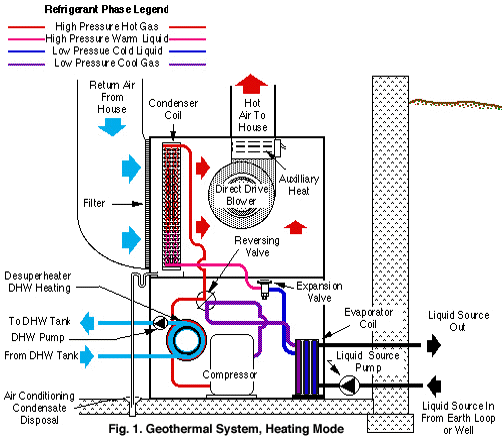
1. The Evaporator Coil is a tube filled with water (Water Source Coil) and sealed inside of another larger tube filled with refrigerant Gas (Tube-In-A-Tube Heat Exchanger or a coaxial).
2. As the cold refrigerant Gas flows through the outside tube of the Evaporator Coil the water flowing through the inside tube of the Evaporator Coil warms the refrigerant Gas. (Purple) The heat pump cycle begins as cold liquid refrigerant passes through a heat exchanger and absorbs heat from the water circulating through the loop.
3. The Compressor then compresses the refrigerant Gas (The Gas that absorbed heat from the water circulating through the loop), causing it to become very hot and under high-pressure, raising its temperature to more than 160 degrees and pushes it into the Reversing Valve. (Red)
4. If the system thermostat is set to heating, then the Reversing Valve moves the hot high-pressure refrigerant Gas into the coil. (Red)
5. As the hot high-pressure refrigerant Gas moves through the Condenser Coil, the Fan blows air over the coil, heating the Conditioned Air Space and cooling the refrigerant Gas. The heat is removed from the refrigerant gas and transferred to air, which is then circulated into your house. (The temperature of the heated air or water is about 100 degrees.) The refrigerant gas cools and condenses into its liquid form as it moves through the Condenser Coil. (Pink)
6. When the cooled refrigerant Liquid moves through the Expansion Valve, the liquid evaporates back into its gaseous form in the Evaporator Coil and gets very cold in the evaporation process. (Blue)
Then the process starts over again.
This is geothermal heating and cooling in cooling.
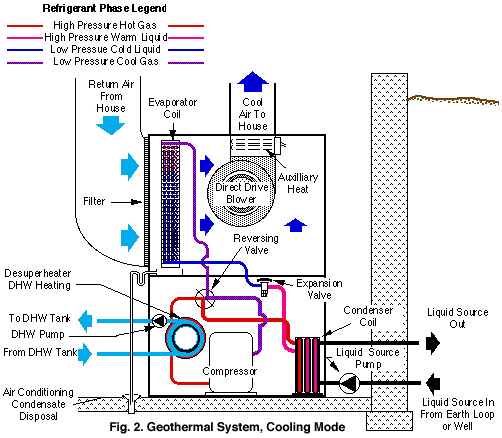
1. The Fan blows air over the Evaporator Coil, cooling the Conditioned Air Space and warming the refrigerant Gas. (Purple) Moving warm air out of your house and through the Evaporator Coil absorbing the heat into the refrigerant Gas.
2. The Compressor compresses the refrigerant Gas (The Gas that absorbed heat from the warm air circulating through house), causing it to become very hot and under high-pressure, and moves it into the Reversing Valve. (Red)
3. If the system thermostat is set to cooling, then the Reversing Valve moves the hot high-pressure refrigerant Gas into the Condenser Coil (Tube-In-A-Tube Heat Exchanger). (Red)
4. As the hot Gas flows through the outside tube of the Condenser Coil the water flowing through the inside tube of the Condenser Coil, heating the water and cooling the refrigerant Gas., and the gas condenses into its liquid form as it cools. (Pink)
5. When the cooled refrigerant Liquid goes through the Expansion Valve, the liquid evaporates back into its gaseous form in the Evaporator Coil and gets very in the evaporation process. (Blue)
Then the process starts over again.
And thats how geothermal heating and cooling works!
can save energy and money with rebates on
heating and cooling solutions for their homes.
Save Now and for Years to Come
Second, it increases the efficiency of the compressor by removing some of the heat from the compressor.
Third, it increases the life expectancy of the compressor by allowing it to operate at a cooler temperature.Thus less future geothermal heating and cooling problems.
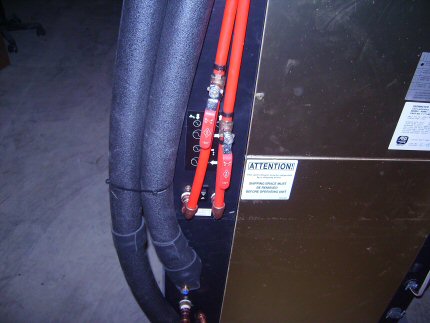
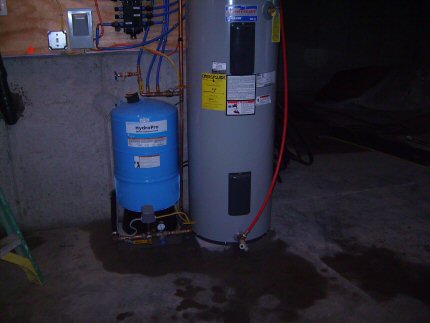
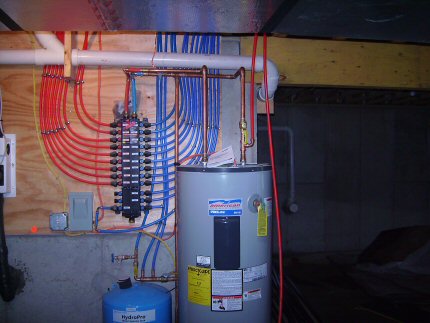
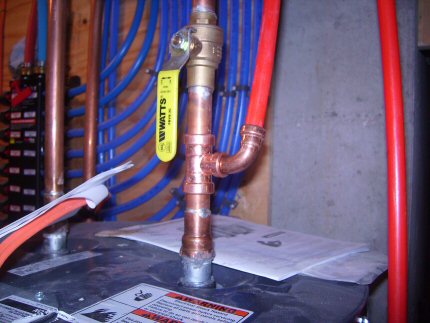
H W G unit hookup H W G hot tank 1 H W G hot tank 2 H W G top of hot water tank H W G bottom of water tank
Closed Loop.
Loops of pipe are buried in deep, vertically-drilled holes, often 200 ft (60 m) and greater below ground level and grouted.
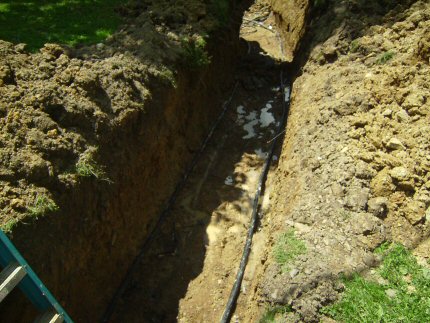
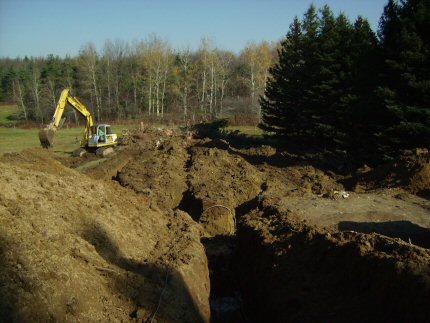
An increasingly popular approach, especially in residential geothermal systems, is a "slinky" coil. A slinky is a coil of plastic tubing spread out and overlapped in a trench and buried. Slinky coils are installed horizontally at the bottom of a three-foot-wide trench. (Depth my vary by location, but at least 5 ft.) This method concentrates the heat transfer surface into small volume, requiring less land area and shorter trenching - a big plus for homeowners.
With a closed loop system the transfer fluid circulates continuously through the heat exchanger (heat pump) and back out through the loops, absorbing heat from the earth during the winter for use inside your home or business. In warmer months, the fluid takes heat from indoors and transfers it back into the earth. Some closed loop systems bypass a portion of their working fluid with a thermostat to keep the source temperature stable.
Open Loop.
Pipes draw water from a nearby water well, shallow body of water or a spring. Once this water passes through the heat pump, it is released back to its source, generally as far from the intake as possible.
Since water from the Earth is a constant temperature (approximately 55 degrees F in the Northeast), the geothermal heat pump has a constant source of 55 degrees F energy with a open loop system.